STR vs LTR for Coastal Homes in San Diego: Which Makes More Sense?
For coastal homeowners in San Diego, choosing between a short-term rental and a long-term rental is not always obvious. A beach-area home may have strong vacation rental appeal, but that does not automatically mean STR is the better strategy.
The right choice depends on your property, income goals, personal use plans, HOA restrictions, local rules, and how involved you want to be.
That is why the short-term vs long-term rentals in San Diego conversation matters so much for coastal owners. In this market, rental strategy is not just about demand. It is also about regulations, licensing, neighborhood conditions, and operational fit.

For some owners, STR offers stronger upside and more flexibility. For others, LTR provides steadier monthly income with fewer moving parts. There is no universal winner.
STR may be the better fit if you want higher earning potential, personal-use flexibility, and are comfortable with more active management and regulation. LTR may be the better fit if you want steadier monthly income, fewer turnovers, and lower day-to-day involvement.
In San Diego, the right answer often depends on licensing, HOA restrictions, neighborhood demand, property type, and how much operational support you have.
What STR Means for Coastal Homes
A short-term rental, or STR, is typically a furnished property rented for shorter guest stays. In San Diego, the City’s Short-Term Residential Occupancy ordinance applies to dwelling units rented for less than one month, and qualifying properties generally require an STRO license within the City.
For coastal homes, STR can be attractive because beach access, views, walkability, outdoor space, and guest-friendly amenities often drive strong demand. Travelers visiting San Diego are usually looking for a full coastal experience, not just a place to sleep.
That is where STR can outperform a traditional monthly rental. A well-positioned vacation rental may benefit from higher nightly rates, seasonal demand, weekend travel, family vacations, and premium guest expectations. For owners who still want personal use throughout the year, STR can also offer more scheduling flexibility than a fixed long-term lease.
But STR also comes with more complexity. A vacation rental operates more like a hospitality business than a standard rental. It requires pricing strategy, guest communication, cleaning coordination, maintenance response, listing optimization, review management, and compliance oversight.
That is why short-term rental management in San Diego matters so much for coastal homes. A property may have strong income potential, but that potential can be lost quickly through poor pricing, slow responses, low-quality turnovers, or compliance mistakes.

What LTR Means for Coastal Homes
A long-term rental, or LTR, is typically rented to a tenant for a longer lease period, usually measured in months rather than nights. Instead of relying on nightly bookings, owners receive more predictable monthly rent from a qualified tenant.
For many coastal homeowners, this is the simpler option. LTRs generally involve fewer turnovers, fewer guest-service demands, and less day-to-day activity than STRs. There is no need to manage check-ins, cleanings, reviews, nightly rate changes, or guest questions.
This stability can be especially appealing for owners who live out of town, prefer lower operational involvement, or want consistent monthly income without the rhythm of vacation rental seasonality.
The tradeoff is upside and flexibility. A long-term tenant may provide reliable income, but the owner usually gives up personal use during the lease term. There is also less opportunity to capture peak-season pricing compared to a well-managed STR.
That said, long-term property management in San Diego can still be a strong strategy when the property fits the right tenant profile, the owner values predictability, or local rental regulations make short-term operations less practical.
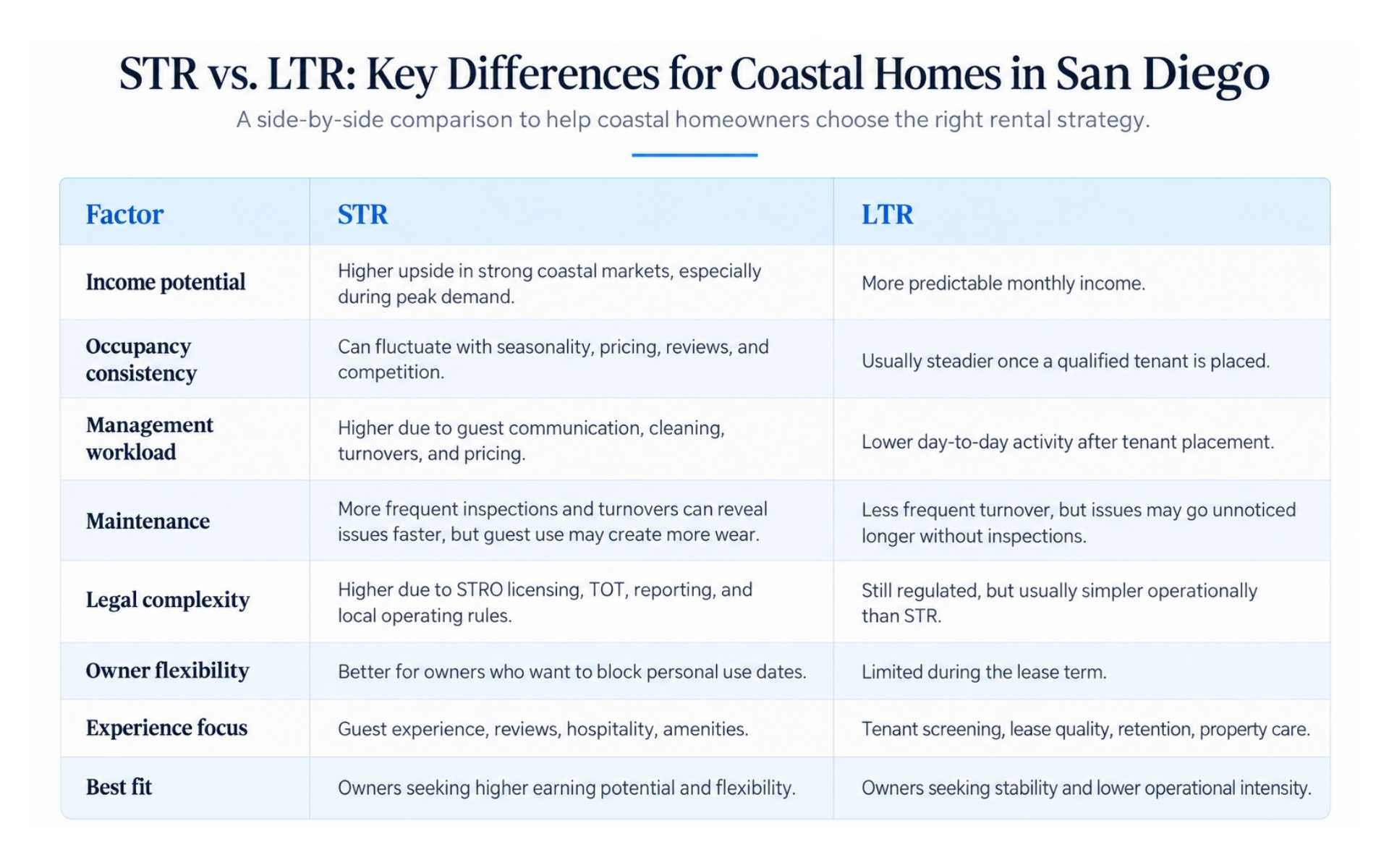
Short-Term vs Long-Term Rentals: Key Differences
When homeowners compare STR vs LTR San Diego, the mistake is often focusing only on gross revenue. A short-term rental may generate higher top-line income, but it can also bring higher expenses, more active management, more regulation, and more wear from frequent guest use.
The better question is not simply, “Which earns more?”
The better question is, “Which strategy produces the best net outcome for this specific property and owner?”
San Diego’s STR rules make this comparison even more important. The City has four STRO license tiers, and a host may only hold one license and operate one dwelling unit for STR at a time. Licenses are also not transferable between ownership or location.
Which Strategy Fits Your Property?
The best coastal home rental strategy depends on what you want the property to do for you.
If You Want Maximum Revenue Potential
STR may make more sense if your home is in a desirable coastal area, has strong guest appeal, and can compete well on presentation, amenities, location, and experience. Homes near beaches, walkable areas, attractions, and family-friendly destinations may perform especially well when professionally marketed and priced.
However, the property still needs to be evaluated carefully. Higher nightly rates do not automatically mean higher net income. Cleaning costs, platform fees, utilities, furnishing, repairs, supplies, taxes, and vacancy periods all matter.
If You Want Lower Stress and Steadier Income
LTR may be the better fit if your main goal is consistent monthly rent, fewer turnovers, and less guest-facing activity. This can be a strong option for owners who prefer simplicity or who do not want to deal with the constant movement of vacation rental operations.
A strong LTR strategy depends heavily on tenant screening, lease management, maintenance planning, and responsive communication.
If You Have a Second Home
STR can be attractive for second-home owners because it may allow personal use between bookings. If you want to visit the property during certain parts of the year, a long-term lease may feel too restrictive.
That said, personal use must be balanced against occupancy rate, seasonal demand, and revenue expectations. Blocking too many high-demand dates can reduce performance.
If You Live Out of Town
Both STR and LTR can work for out-of-town owners, but both require professional support. STR requires local response, cleaning coordination, inspections, guest support, and compliance monitoring. LTR requires tenant screening, rent collection, maintenance coordination, and property oversight.
For remote owners, the real question is which strategy can be managed reliably without daily involvement.
If You Want Flexibility
A hybrid strategy may also be worth evaluating. Some owners use STR during stronger travel seasons and consider monthly rental or mid-term rental options during slower periods. This is not always possible or ideal, but for some homes, it can create a more balanced approach.
The key is making sure the strategy aligns with licensing, HOA rules, demand patterns, and the actual condition of the property.
San Diego Factors That Matter
San Diego is not a market where homeowners should casually choose STR without understanding the rules. The city’s San Diego short-term rental laws can materially affect the decision.
The City of San Diego’s official STRO page states that Tier 1, 2, and 3 applications are open, while Tier 4, which applies to Mission Beach whole-home STRs, is closed. As of May 8, 2026, the City reported 856 remaining Tier 3 licenses and 0 remaining Tier 4 licenses.
That matters because the same coastal property can have a different strategy depending on where it is located.
Because rental regulations can change, homeowners should verify current STRO requirements directly with the City of San Diego before making a final rental strategy decision.

STRO Licensing and Permit Tiers
San Diego’s STRO tier system separates rentals based on use type, number of rental days, whether the host resides onsite, and whether the property is in Mission Beach.
Tier 3 applies to whole-home STRs outside the Mission Beach Community Planning Area for more than 20 days per year. Tier 4 applies to whole-home STRs within Mission Beach for more than 20 days per year.
City Caps and Availability
The number of Tier 3 licenses is capped at 1% of San Diego’s total housing units outside Mission Beach. Tier 4 licenses are capped at 30% of the Mission Beach Community Planning Area.
This means STR viability can depend not only on demand, but also on license availability.
Taxes and Reporting
If a San Diego property is rented for less than one month per guest stay, the owner or operator must obtain a Transient Occupancy Tax Certificate and collect and remit TOT. The City also notes Rental Unit Business Tax responsibilities for owners renting property for more than six days in a calendar year.
For Tier 3 and Tier 4 licenses, the City requires a minimum of 90 days of STRO use per year and quarterly reports to demonstrate utilization. Failure to meet that requirement can put the license at risk.
Seasonality and Coastal Competition
Seasonality matters. A coastal San Diego home may see stronger demand during summer, holidays, school breaks, and major local events. But off-season performance can vary depending on pricing, amenities, reviews, photography, and market saturation.
A property that performs well in July may need a different pricing and marketing strategy in January.
HOA Restrictions
Even if the City allows STR use, an HOA may restrict or prohibit short-term rentals. Before choosing STR, owners should review HOA documents, CC&Rs, minimum rental periods, guest parking rules, noise policies, and any approval requirements.
Guest Expectations in Coastal Areas
Vacation guests in coastal San Diego expect more than beach access. They expect clean spaces, easy check-in, fast communication, accurate listings, reliable Wi-Fi, stocked essentials, comfortable beds, and a smooth arrival experience.
That is why guest experience directly affects STR performance. Better guest experience can lead to stronger reviews, better conversion, and repeat bookings.
How Property Management Changes the Outcome
The difference between a good strategy and a poor one often comes down to execution.
A coastal home may look perfect for STR, but if it is underpriced, poorly photographed, slow to respond to guests, or not properly maintained, it may underperform. A home may also seem better suited for LTR, but weak tenant screening or delayed maintenance can create avoidable problems.

Professional coastal property management in San Diego helps owners compare both paths more realistically.
For STRs, a property manager can help with dynamic pricing, listing optimization, guest screening, turnovers, maintenance coordination, and guest support. The Coastal Project’s short-term rental management service emphasizes dynamic pricing, professional hospitality, and 24/7 guest care for coastal homes.
For LTRs, management focuses more on tenant screening, lease quality, rent collection, inspections, legal compliance, and reliable maintenance. The Coastal Project’s long-term rental management service highlights tenant screening, maintenance coordination, lease management, and predictable income support for homeowners.
The value is not only convenience. A strong property manager helps owners avoid operational gaps that affect income, reviews, tenant quality, compliance, and long-term property value.
For homeowners comparing both paths, The Coastal Project’s San Diego property management services can help evaluate whether STR, LTR, or a hybrid approach fits the property best.
Common Mistakes to Avoid
Choosing between vacation rental vs monthly rental is a strategic decision. Homeowners often get into trouble when they choose based on assumptions instead of a full property review.
Choosing Based Only on Gross Revenue
STR income can look attractive, but gross revenue is not the full picture. Owners should compare net income after management fees, cleaning, utilities, supplies, maintenance, platform fees, taxes, insurance, vacancy, and furnishing costs.
Ignoring Licensing and Tax Obligations
San Diego short-term rental laws should be reviewed before launching any STR strategy. Operating without the right license or tax setup can create unnecessary risk.
Underestimating Turnover and Maintenance
STRs require frequent cleaning, inspections, restocking, and maintenance. This is manageable with the right system, but it can become overwhelming for owners trying to self-manage.
Forgetting HOA Restrictions
HOA restrictions can stop an STR strategy before it starts. Always review the HOA rules before assuming a property can operate as a vacation rental.
Failing to Account for Seasonality
Occupancy rate can change across the year. A strong rental strategy should plan for peak season, shoulder season, and slower months.
Not Matching the Strategy to the Property Type
Not every coastal home should be an STR. Some homes are better suited for long-term tenants because of layout, parking, HOA rules, location, condition, or owner priorities.
So, Is STR Better Than LTR in San Diego?
Sometimes, yes. But not always.
STR can make more sense when the property has strong coastal appeal, the owner wants personal use flexibility, the licensing path is clear, and the home can support a premium guest experience.
LTR can make more sense when the owner values predictable income, wants lower operational complexity, or the property is not ideal for short-term guest demand.
For many San Diego coastal homeowners, the smartest move is not choosing blindly. It is evaluating the property through both lenses: income potential, rules, workload, risk, flexibility, and long-term goals.
The right strategy should protect the home, fit the owner’s lifestyle, and create a rental plan that can perform consistently.
Not Sure Which Strategy Fits Your Coastal Home?
Before choosing between STR and LTR, it helps to compare the numbers, rules, and operational requirements for your specific property.
The Coastal Project can help you evaluate whether short-term rental management, long-term rental management, or a hybrid approach makes the most sense for your San Diego coastal home.
Schedule a strategy meeting to compare your short-term and long-term rental options before making a decision.
FAQs
Is STR Better Than LTR in San Diego?
STR can offer higher income potential in some coastal San Diego areas, especially when the property is well-located, professionally marketed, and properly managed. However, LTR may be better for owners who want stable monthly income, fewer turnovers, and less operational complexity. The better choice depends on the property, regulations, HOA restrictions, and owner goals.
How Much Can a Coastal Home Earn as a Short-Term Rental?
Earnings depend on location, seasonality, home size, amenities, guest experience, pricing strategy, photography, reviews, and local competition. A coastal home near the beach may have strong potential, but homeowners should evaluate net income rather than gross revenue alone.
Are Short-Term Rentals Legal in San Diego?
Yes, short-term rentals can be legal in San Diego, but they are regulated. The City requires an STRO license for qualifying rentals of less than one month, and operators may also need a Transient Occupancy Tax Certificate and must follow the applicable tier rules.
Which Is Easier to Manage, STR or LTR?
LTR is usually easier to manage day to day because it involves fewer turnovers, fewer guest interactions, and more predictable monthly income. STR requires more active management, including guest communication, cleaning, pricing, inspections, and compliance.
Can One Property Switch From STR to LTR?
Yes, in many cases a property can switch from STR to LTR, but homeowners should review licensing, lease timing, HOA rules, market demand, and financial projections before changing strategies. A property manager can help evaluate whether switching makes sense.
What Should Homeowners Check Before Choosing a Rental Strategy?
Homeowners should review expected net income, STRO licensing requirements, HOA restrictions, tax obligations, occupancy rate expectations, maintenance needs, seasonality, personal use plans, and whether the property is better suited for guests or long-term tenants.